A Frightening Thought
It would be extremely dangerous to allow media monopolies who would then have the power to
abuse their power, keep the truth from the public, lie, with-hold vital information and reporting
and publicise biased opinions. This is not freedom. This is not democracy.
This is not what Australia needs or wants. Our country then would be on a par with
communist countries who control the daily lives of their people.
Did Aussie Diggers fight for this? To see their country go backwards over one hundred years? To go back to an earlier age when there was no freedom of speech, to live in a world where if you speak out against the government or elected leaders you face the terror of being thrown in gaol? To be subjected to brain-washing?
Because this is what a media monopoly would have - the power to control our very lives, to tell us what to think, to tell us what they want us to know, to keep the truth from us.
A Dreadful Reality
Free reign to control every last newspaper, TV and radio station in Australia --Rupert Murdoch’s fantasy could become a frightening reality
unless we stand in his way right now.
A government review is recommending we eliminate ownership limits -- exactly what Murdoch asked for. But we have two weeks to flood the review with objections to their plan during the public comment period before they finalise the report. Unless thousands of us speak out, the recommendations could go forward unchallenged.
Nobody -- especially not Rupert Murdoch -- should be allowed to own all of our media. Let’s wake up the review with our call -- and prevent the Murdoch Mafia from growing even larger. INFORMATION HERE.

Click on Flag or Select Language to Translate

Kangaroo

Thursday, January 19, 2012


36. Wikipedia Black-Out Because of the USA
Today, I couldn't find info on Wikipedia, (English Wikipedia) - the page is BLACKED OUT
Why? I'll tell you why - As a protest because the U.S. Congress is considering legislation that could fatally damage the free and open Internet.
First, they wanted Julian Assange's head on a platter,
now...
They want to control Wikipedia! (SOPA and PIPA)

What are SOPA and PIPA?
"SOPA and PIPA represent two bills in the United States House of Representatives and the United States Senate respectively. SOPA is short for the "Stop Online Piracy Act," and PIPA is an acronym for the "Protect IP Act." ("IP" stands for "intellectual property.")"
Read about SOPA and PIPA
SOPA (Stop Online Piracy Act) known as House Bill 3261 was introduced in the House of Representatives on October 26, 2011 and if made law, "would expand the ability of U.S. law enforcement and copyright holders to fight online trafficking in copyrighted intellectual property and counterfeit goods."
"To promote prosperity, creativity, entrepreneurship, and innovation by combating the theft of U.S. property, and for other purposes." —H.R. 3261
IN the link above it also states "it will threaten whistle-blowing and other free speech actions" (Like Julian Assange?)
PIPA "The PROTECT IP Act (Preventing Real Online Threats to Economic Creativity and Theft of Intellectual Property Act of 2011 or PIPA), also known as Senate Bill 968 or S. 968, is a proposed law with the stated goal of giving the US government and copyright holders additional tools to curb access to "rogue websites dedicated to infringing or counterfeit goods", especially those registered outside the U.S."
"The bill defines infringement as distribution of illegal copies, counterfeit goods, or anti-digital rights management technology. Infringement exists if "facts or circumstances suggest [the site] is used, primarily as a means for engaging in, enabling, or facilitating the activities described."
So does this mean no more YouTube?
Russia and China one could (maybe) understand, but the US? Aren't they supposed to be the land of the free? What is the USofA trying to do? Isn't this what they have always done - stuck their nose in other peoples and other countries business? They have too many fingers in too many pies, hey America, wake up! I'm not an American, I don't live in America and I certainly do not want to be ruled by yourso called laws.
Now .... according to This site Obama has said he won't support either bill (SOPA or PIPA) as is but ....
And get this SOPA and PIPA are bills originally drafted by two Democratic leaders to appease the Hollywood sponsors to allow them the ability to bring copyright infringed websites to their knees should they or a commenter violate any far reaching scope of current copyright laws. It’s so broad, that if a commenter links to a copyrighted video on You Tube, production companies and Hollywood Film companies have the right to have the website shut down and have it’s advertisers withhold their earnings.
And the USofA calls itself the "land of the Free" huh, pull the other one. America a democracy? More like an elected dictatorship. They're too big for their damn boots and need taking down a peg or do.
America, keep your hands to yourself.
A quote from Scrooge seems appropriate here Bah! Humbug!
Why? I'll tell you why - As a protest because the U.S. Congress is considering legislation that could fatally damage the free and open Internet.
First, they wanted Julian Assange's head on a platter,
now...
They want to control Wikipedia! (SOPA and PIPA)

What are SOPA and PIPA?
"SOPA and PIPA represent two bills in the United States House of Representatives and the United States Senate respectively. SOPA is short for the "Stop Online Piracy Act," and PIPA is an acronym for the "Protect IP Act." ("IP" stands for "intellectual property.")"
Read about SOPA and PIPA
SOPA (Stop Online Piracy Act) known as House Bill 3261 was introduced in the House of Representatives on October 26, 2011 and if made law, "would expand the ability of U.S. law enforcement and copyright holders to fight online trafficking in copyrighted intellectual property and counterfeit goods."
"To promote prosperity, creativity, entrepreneurship, and innovation by combating the theft of U.S. property, and for other purposes." —H.R. 3261
IN the link above it also states "it will threaten whistle-blowing and other free speech actions" (Like Julian Assange?)
PIPA "The PROTECT IP Act (Preventing Real Online Threats to Economic Creativity and Theft of Intellectual Property Act of 2011 or PIPA), also known as Senate Bill 968 or S. 968, is a proposed law with the stated goal of giving the US government and copyright holders additional tools to curb access to "rogue websites dedicated to infringing or counterfeit goods", especially those registered outside the U.S."
"The bill defines infringement as distribution of illegal copies, counterfeit goods, or anti-digital rights management technology. Infringement exists if "facts or circumstances suggest [the site] is used, primarily as a means for engaging in, enabling, or facilitating the activities described."
So does this mean no more YouTube?
Russia and China one could (maybe) understand, but the US? Aren't they supposed to be the land of the free? What is the USofA trying to do? Isn't this what they have always done - stuck their nose in other peoples and other countries business? They have too many fingers in too many pies, hey America, wake up! I'm not an American, I don't live in America and I certainly do not want to be ruled by your
Now .... according to This site Obama has said he won't support either bill (SOPA or PIPA) as is but ....
And get this SOPA and PIPA are bills originally drafted by two Democratic leaders to appease the Hollywood sponsors to allow them the ability to bring copyright infringed websites to their knees should they or a commenter violate any far reaching scope of current copyright laws. It’s so broad, that if a commenter links to a copyrighted video on You Tube, production companies and Hollywood Film companies have the right to have the website shut down and have it’s advertisers withhold their earnings.
And the USofA calls itself the "land of the Free" huh, pull the other one. America a democracy? More like an elected dictatorship. They're too big for their damn boots and need taking down a peg or do.
America, keep your hands to yourself.
A quote from Scrooge seems appropriate here Bah! Humbug!
Sunday, December 25, 2011
35. Christmas in Australia
Christmas "Downunder"
Christmas "Downunder" is hot, often muggy and the sun beats down on your head. Unlike those in the Northern Hemisphere where Christmas is cold, wet and snowing with people rugged up in their winter woolies tucking into a a veritable feast of hot dishes followed by a hot steaming pudding, here in Australia, it's a singlet, shorts and thongs - too bloody hot to be all dolled up to the nines! Too right too. I rang mum to wish her merry Christmas and said, "Mum, today is a traditional Australian Christmas - stinking hot and humid." Just like Christmas used to be when I was a kiddie.
This song sort of depicts the Christmas in Australia - not everyone has a bbq
Christmas Dinner
Whether you're having your Christmas meal at lunchtime or tea time, it's still "Dinner" - when eating in the middle of the day, it's lunch, when eaten for the evening meal it's tea. Not to be confused with tea as in a cup of tea, tea in Australia is dinner time. Confusing eh? Not really, we know what we mean - today at our house we had Christmas Dinner which was a Christmas lunch at lunchtime.
Summer Makes No Difference
Now, you might think that being summer, we Aussies would content ourselves with a summer salad, a lovely light refreshing meal with tomatoes and lettuce. Huh! Not on your nelly. Here in Australia we have our "traditions" just like our brothers across the oceans - a selection of hot meats - baked ham, roast leg 'o lamb, baked spuds and pumpkins, two types of greens (in this case broccoli and beans) served with hot gravy. Naturally. So there was I, busily stirring the gravy, sweat pouring down my face, into my eyes, my glasses got fogged up, as I valiantly tried to see how the gravy was going.
Potato salad had been made last night. Actually, it was made very late last night and put together just after midnight. We've had a run of hot days recently, the house has a flat roof and you get a free sauna - inside temps over the 30's. Easy over 30.
The Pièce de Résistance
As anybody in our family will tell you - it's the Christmas Pudding, a beautiful, delectable, mouth-watering delicacy filled with fruits and brandy, served with lashings of runny cream.
My lovely daughter-in-law who is now my second daugher, has taken over the making of the Christmas Pudding for the last two years (and a wonderful job she does too) told me, the pudding went mouldy I had to throw it out, went everywhere trying to find one to buy, could only find two small ones. (They fly down from Sydney a day or two before Christmas Day.) Never mind, she was here and that's more important.
After being re-boiled, the pud is place on a plate, brought out to the table and brandy poured over it then lit with a light and the glorious blue flames from the burning alcohol rise up. Except I knocked the bottle over, the pudding went swimming and everybody got drunk! Just kidding, although I was rather heavy-handed with the brandy though.
We all nearly split our side laughing when eldest son proudly carried out the two puddings on a rectangular plate - they looked just like a pair of knockers and naturally he made reference to this (although slightly different words were used) We thought it hilarious because they did in fact look exactly like that!
It is now nearly half past nine at night and the house is still hot as a furnace. Ah well, perhaps I could sleep on the roof tonight. Wouldn't that be a thought now.
I will end with one of my favourite Australian Christmas carols - The Three Drovers. We learnt this at school when I was in grade 3.
Merry Christmas from Downunder.
Christmas "Downunder" is hot, often muggy and the sun beats down on your head. Unlike those in the Northern Hemisphere where Christmas is cold, wet and snowing with people rugged up in their winter woolies tucking into a a veritable feast of hot dishes followed by a hot steaming pudding, here in Australia, it's a singlet, shorts and thongs - too bloody hot to be all dolled up to the nines! Too right too. I rang mum to wish her merry Christmas and said, "Mum, today is a traditional Australian Christmas - stinking hot and humid." Just like Christmas used to be when I was a kiddie.
This song sort of depicts the Christmas in Australia - not everyone has a bbq
Christmas Dinner
Whether you're having your Christmas meal at lunchtime or tea time, it's still "Dinner" - when eating in the middle of the day, it's lunch, when eaten for the evening meal it's tea. Not to be confused with tea as in a cup of tea, tea in Australia is dinner time. Confusing eh? Not really, we know what we mean - today at our house we had Christmas Dinner which was a Christmas lunch at lunchtime.
Summer Makes No Difference
Now, you might think that being summer, we Aussies would content ourselves with a summer salad, a lovely light refreshing meal with tomatoes and lettuce. Huh! Not on your nelly. Here in Australia we have our "traditions" just like our brothers across the oceans - a selection of hot meats - baked ham, roast leg 'o lamb, baked spuds and pumpkins, two types of greens (in this case broccoli and beans) served with hot gravy. Naturally. So there was I, busily stirring the gravy, sweat pouring down my face, into my eyes, my glasses got fogged up, as I valiantly tried to see how the gravy was going.
Potato salad had been made last night. Actually, it was made very late last night and put together just after midnight. We've had a run of hot days recently, the house has a flat roof and you get a free sauna - inside temps over the 30's. Easy over 30.
The Pièce de Résistance
As anybody in our family will tell you - it's the Christmas Pudding, a beautiful, delectable, mouth-watering delicacy filled with fruits and brandy, served with lashings of runny cream.
My lovely daughter-in-law who is now my second daugher, has taken over the making of the Christmas Pudding for the last two years (and a wonderful job she does too) told me, the pudding went mouldy I had to throw it out, went everywhere trying to find one to buy, could only find two small ones. (They fly down from Sydney a day or two before Christmas Day.) Never mind, she was here and that's more important.
After being re-boiled, the pud is place on a plate, brought out to the table and brandy poured over it then lit with a light and the glorious blue flames from the burning alcohol rise up. Except I knocked the bottle over, the pudding went swimming and everybody got drunk! Just kidding, although I was rather heavy-handed with the brandy though.
We all nearly split our side laughing when eldest son proudly carried out the two puddings on a rectangular plate - they looked just like a pair of knockers and naturally he made reference to this (although slightly different words were used) We thought it hilarious because they did in fact look exactly like that!
It is now nearly half past nine at night and the house is still hot as a furnace. Ah well, perhaps I could sleep on the roof tonight. Wouldn't that be a thought now.
I will end with one of my favourite Australian Christmas carols - The Three Drovers. We learnt this at school when I was in grade 3.
Merry Christmas from Downunder.
Friday, December 23, 2011
34. This Land of Ours
Doth stretch before the eye
And show unto me all the beauty
Of a far and distant past.
Of gums so tall
And eucalypt
They tower o'er me
And sweet their fragrance to inhale
Their beauty for to see.
Oh yes, this precious land of mine
With all your beauty free
And listen to the sweet carol
Of birds in fancy free.
My country you are more to me
Than earth of fire or sky
For I shall love this land of ours
Until the day I die.
Tuesday, November 15, 2011
33. Map of Australia & Capital Cities

Capital Cities
The capital of Australia is: Canberra which is in the A.C.T.
The capital of Western Australia is: Perth
The capital of Northern Territory is: Darwin
The capital of Queensland is : Brisbane
The capital of New South Wales is: Sydney
The capital of Victoria is: Melbourne
The capital of South Australia: Adelaide
The capital of Tasmania is: Hobart
Monday, November 14, 2011
32. Australian Hall of Fame
1. Don Bradman
In a career of 80 tests with a batting average of 99.94, Sir Donald Bradman is regarded as the greatest cricketer of all time. He was known by one and all as 'the Don'.
 Above: Don Bradman's Blazer & Bat
2. The Meat Pie
The staple diet of Australian truckies, construction workers and all decent hard working Australians. Consumed with sauce, held in the hand and never, never eaten with a knife and fork.
 Above: Pie'n'sauce
3. Vegemite
A fair dinkum Aussie icon - brown stuff that you spread on toast, bread and dry bikkies. Found in 90% of Australian homes, is it any wonder 22 million jars are sold every year?!
 Above: Vegemite
4. Victoria Bitter
The greatest beer of all time - "For a hard earned thirst, you need a big cold beer, and the best cold beer is Vic, Victoria Bitter"
 Above: Victoria Bitter
5. Thongs
A real Aussie icon classic, the undisputed all time Australian footwear item. Costs as little as $2 and have been known to last for years. The advantage of thongs is you don't have to bend over when putting them on or taking them off.
Insert right foot, insert left foot and Bob's your uncle! Off you go now.
 Above: Thongs
6. Skippy
Our greatest television star - he knew whenever anyone was in trouble in the outback area of Warratah National Park, he was a life saver, solved crimes, and an all-round super-duper hero. During the 60's and 70's, hundreds of little boys and girls tried to whistle through a gum leaf thereby spluttering food in all directions!
 Above: Skippy
7. The Melbourne Cup
A horse race. Australia's biggest and richest. Held the first Tuesday in November at Flemington. IN the red-roofed homes all over Australia, in office buildings and road works, people stop what they're doing and listen to the running of "The Cup". It's a public holiday in Victoria.
 Above: The Melbourne Cup
8. The Beach
With a coastline of 36,735 kms - the beach is just the place for a nice day out. Loved by surfers, swimmers, mums and dads and kiddies alike.
 Above: The Beach
9. Number 96
One of the first Australian serials, it was set in a Sydney block of flats. With a big helping of larger-than-life characters, a hint of campness and, wait for it - sex! Everybody remembers Abigail, she of the big...she had blonde hair and a lovely smile.
 Above: Abigail
10. The Mullet
A haircut - cut (very) short at the front and sides and long at the back. Le Mullet is the world's best/worst haircut (depending on one's point of view). It can be combined with a long fringe, no fringe, rats tales, dreadlocks and even a receding hairline.
 Above: The Mullet
In a career of 80 tests with a batting average of 99.94, Sir Donald Bradman is regarded as the greatest cricketer of all time. He was known by one and all as 'the Don'.

2. The Meat Pie
The staple diet of Australian truckies, construction workers and all decent hard working Australians. Consumed with sauce, held in the hand and never, never eaten with a knife and fork.

3. Vegemite
A fair dinkum Aussie icon - brown stuff that you spread on toast, bread and dry bikkies. Found in 90% of Australian homes, is it any wonder 22 million jars are sold every year?!

4. Victoria Bitter
The greatest beer of all time - "For a hard earned thirst, you need a big cold beer, and the best cold beer is Vic, Victoria Bitter"

5. Thongs
A real Aussie icon classic, the undisputed all time Australian footwear item. Costs as little as $2 and have been known to last for years. The advantage of thongs is you don't have to bend over when putting them on or taking them off.
Insert right foot, insert left foot and Bob's your uncle! Off you go now.

6. Skippy
Our greatest television star - he knew whenever anyone was in trouble in the outback area of Warratah National Park, he was a life saver, solved crimes, and an all-round super-duper hero. During the 60's and 70's, hundreds of little boys and girls tried to whistle through a gum leaf thereby spluttering food in all directions!

7. The Melbourne Cup
A horse race. Australia's biggest and richest. Held the first Tuesday in November at Flemington. IN the red-roofed homes all over Australia, in office buildings and road works, people stop what they're doing and listen to the running of "The Cup". It's a public holiday in Victoria.

8. The Beach
With a coastline of 36,735 kms - the beach is just the place for a nice day out. Loved by surfers, swimmers, mums and dads and kiddies alike.

9. Number 96
One of the first Australian serials, it was set in a Sydney block of flats. With a big helping of larger-than-life characters, a hint of campness and, wait for it - sex! Everybody remembers Abigail, she of the big...she had blonde hair and a lovely smile.

10. The Mullet
A haircut - cut (very) short at the front and sides and long at the back. Le Mullet is the world's best/worst haircut (depending on one's point of view). It can be combined with a long fringe, no fringe, rats tales, dreadlocks and even a receding hairline.

Friday, November 11, 2011
31. Remembrance Day 2011
Today is Remembrance Day. At the 11th hour of the 11th day of the 11th month, 1918, the guns of war fell silent. Remembrance Day, or Armistice Day as it was originally known, was to remember those who gave their lives for our freedom in what was called the "Great War" - the War To End All Wars. But, as the years rolled by, it was not to be - there were other wars and so today, Remembrance Day is to remember all Australian soldiers who fought and those who died in all wars.
 Above: Remembrance Day poster
Hellfire Pass
The story of Hellfire Pass is from World War II, in a place called Kanchanaburi, Thailand. I went there earlier this year because of its history - a brutal and terrible history.
A Life For Every Sleeper
 Above: Original track work of the Death Railway
One POW died for every 32.6 metres of track.
There were 424 thousand metres of track.
13,000 died and are buried along the way.
Over 80,000 Asian labourers died.
For every sleeper laid it cost one human life
120,000 sleepers where laid.
Japanese brutality at its best.
Hellfire Pass ~ Honouring The Fallen
+
 Above: Information Sign
At the beginning of doing this walk this sign reads:
The railway has been cleared for a further four kilometres but no improvements have been made to steep or difficult sections. Only those persons in good physical condition should attempt this part of the trail. Walking time from this point to the end and return is 3 hours.
 Above: Tree of Life
This self-seeded tree grew in the middle of Hellfire Pass. Where once cruelty and death lingered, the appearance of the birth of a new tree gives hope. Tree of life is a metaphor for the livelihood of the spirit.
 Above: Railbed
As you walk along this track today, it is a peaceful place with the sound of crickets and cicadas singing and the stones crunching under your walking feet. No-one who comes here shouts or yells - something about the atmosphere begs for the listener to be still and breathe in the winds of today which have overcome the trials of yesterday. It is not until you reach the memorials that you realise it is not all it seems it is not a pretty walk in the country but a living memorial to thousands of men who lived, worked and died many still in their teens or early twenties. Young men who never had the chance to live and learn about the joys of happiness which we take for granted.
So... be still take a quiet time and sit and just do nothing but listen to the wind as it ruffles your hair and the sun beats down overhead as it did oh so many years ago on others who were here first.
HELLFIRE PASS
Cuttings along the railway varied from shallow earth to deep rock. Konyu Cutting, or Hellfire Pass as it was known, is the deepest and largest on the entire length of the railway.
On 25th April 1943 - ANZAC Day - work commenced to excavate the cutting. A workforce of prisoners of war began the task of hacking back the jungle, removing the loose earth and drilling in rock by hand. Little machinery was available. Most of the drilling work was done by the "hammer and tap" men, a process whereby one man would hold and rotate a drill or "tap" while his mate hit the head of the drill with an eight to ten pound hammer.
 Above: Sheer rockface - the hill was excavated by hand
'Pick up.
Carry 25 yards or more.
Up the bank.
Dump.
Walk back.'
'On jobs such as cuttings, Nips stood overhead and threw stones all the time irrespective of whether you worked or not.' - Reg Holloway, 2/40th Infantry Battalion, Australian Imperial Force.
 Above: In Memory
When the hole was deep enough, explosive charges would be used, the broken rock removed by hand and the process began again. The process was slow.
As work fell behind schedule and "speedo" was called, the work rate intensified. Work shifts lasting up to eighteen hours drilled, blasted and removed rock in a continuous operation. The men laboured under intense pressure from the Japanese engineers and Korean guards at the height of the wettest monsoon season for many years. Such was the brutality that 69 men were beaten to death by their guards.
 Above: In Remembrance
Many prisoners-of-war died from cholera, beriberi, dysentery, starvation, and exhaustion. On starvation rations - a cup of boiled rice or millet three times a day - if they were lucky, malnutrition was a big killer.
At night, the cutting was lit by fires, lamps or diesel torches. The eerie light and shadows of guards and gaunt prisoners of war playing on the rock walls suggested the name the site was given - Hellfire Pass.
 Above: POW - Original photo
An original photo of a POW standing beside the primitive tripod which was used for levelling the ground of the Death Railway Thailand - Burma
 Above: Hellfire Pass, 1944
Original photo of Hellfire Pass (Konyu Cutting) which forms part of the Death Railway, was a particularly difficult section of the line to build, not only because it was the largest rock cutting on the railway, but also because of its remoteness and the lack of proper construction tools during building.
 Above: Hellfire Pass today
These rails and sleepers are from the official railway and were relaid in Konyu Cutting in April 1989 by the men of "C" Company 3rd Battalion Royal Australian Regiment.
They were relocated to the current position in 2006.
 Above: Memorial
One of the most poignant memories is of a plain little wooden cross that said simply "For my Dad"
 Above: The Australian flag
 Above: Hellfire Pass
The plaque on the left is dedicated to Sir Edward "Weary" Dunlop (1907 - 1993) and reads ~
Patron of the Association of and Surgeon of the jungle whose ashes were scattered in this area on 25th April 1994.
From 1942 to 1945 Weary Dunlop and his medical colleagues, in the Armed Services of Great Britain, Australia, Netherlands, India and the United States of America gave devoted service to thousands of sick and dying prisoners-of-war and Asian labourers who were forced to construct and maintain the Burma-Thailand Railway.
These doctors provided leadership, helped alleviate pain and suffering and above all gave reason to live when all real hope seemed lost.
To them we all give thanks.
"When you go home, tell them of us and say we gave our tomorrow for your today"
 Above: Hellfire Pass Memorial
Of the 1,000 Australian and British soldiers who took 12 weeks to clear the stretch of mountain, 700 died. They worked around the clock for 16-18 hours a day to complete excavation of the 17 metre deep and 110-m long cutting through solid limestone and quartz rock.
The Hellfire Pass Memorial and Memorial Museum were set up to commemorate these fallen.
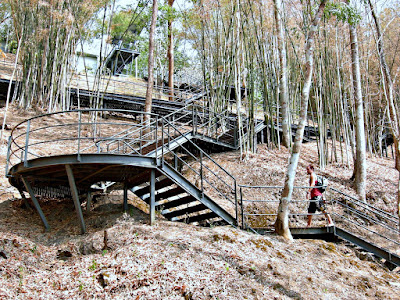 Above: 352 steps
This is the number of steps to reach Hellfire Pass. Many are steep and climbing down and then back up face running with sweat sun beating down I look back at what was once one of the most dreaded railways in history - the "Death Railway" and ask how could so much human suffering and atrocity be caused by one human being to another?
Walk Through Hellfire Pass
+
In Remembrance of
All those who suffered
And all who died.


Hellfire Pass
The story of Hellfire Pass is from World War II, in a place called Kanchanaburi, Thailand. I went there earlier this year because of its history - a brutal and terrible history.
A Life For Every Sleeper

There were 424 thousand metres of track.
13,000 died and are buried along the way.
Over 80,000 Asian labourers died.
For every sleeper laid it cost one human life
120,000 sleepers where laid.
Japanese brutality at its best.

At the beginning of doing this walk this sign reads:
The railway has been cleared for a further four kilometres but no improvements have been made to steep or difficult sections. Only those persons in good physical condition should attempt this part of the trail. Walking time from this point to the end and return is 3 hours.

This self-seeded tree grew in the middle of Hellfire Pass. Where once cruelty and death lingered, the appearance of the birth of a new tree gives hope. Tree of life is a metaphor for the livelihood of the spirit.

As you walk along this track today, it is a peaceful place with the sound of crickets and cicadas singing and the stones crunching under your walking feet. No-one who comes here shouts or yells - something about the atmosphere begs for the listener to be still and breathe in the winds of today which have overcome the trials of yesterday. It is not until you reach the memorials that you realise it is not all it seems it is not a pretty walk in the country but a living memorial to thousands of men who lived, worked and died many still in their teens or early twenties. Young men who never had the chance to live and learn about the joys of happiness which we take for granted.
So... be still take a quiet time and sit and just do nothing but listen to the wind as it ruffles your hair and the sun beats down overhead as it did oh so many years ago on others who were here first.
HELLFIRE PASS
Cuttings along the railway varied from shallow earth to deep rock. Konyu Cutting, or Hellfire Pass as it was known, is the deepest and largest on the entire length of the railway.
On 25th April 1943 - ANZAC Day - work commenced to excavate the cutting. A workforce of prisoners of war began the task of hacking back the jungle, removing the loose earth and drilling in rock by hand. Little machinery was available. Most of the drilling work was done by the "hammer and tap" men, a process whereby one man would hold and rotate a drill or "tap" while his mate hit the head of the drill with an eight to ten pound hammer.

'Pick up.
Carry 25 yards or more.
Up the bank.
Dump.
Walk back.'
'On jobs such as cuttings, Nips stood overhead and threw stones all the time irrespective of whether you worked or not.' - Reg Holloway, 2/40th Infantry Battalion, Australian Imperial Force.

When the hole was deep enough, explosive charges would be used, the broken rock removed by hand and the process began again. The process was slow.
As work fell behind schedule and "speedo" was called, the work rate intensified. Work shifts lasting up to eighteen hours drilled, blasted and removed rock in a continuous operation. The men laboured under intense pressure from the Japanese engineers and Korean guards at the height of the wettest monsoon season for many years. Such was the brutality that 69 men were beaten to death by their guards.

Many prisoners-of-war died from cholera, beriberi, dysentery, starvation, and exhaustion. On starvation rations - a cup of boiled rice or millet three times a day - if they were lucky, malnutrition was a big killer.
At night, the cutting was lit by fires, lamps or diesel torches. The eerie light and shadows of guards and gaunt prisoners of war playing on the rock walls suggested the name the site was given - Hellfire Pass.

An original photo of a POW standing beside the primitive tripod which was used for levelling the ground of the Death Railway Thailand - Burma

Original photo of Hellfire Pass (Konyu Cutting) which forms part of the Death Railway, was a particularly difficult section of the line to build, not only because it was the largest rock cutting on the railway, but also because of its remoteness and the lack of proper construction tools during building.

These rails and sleepers are from the official railway and were relaid in Konyu Cutting in April 1989 by the men of "C" Company 3rd Battalion Royal Australian Regiment.
They were relocated to the current position in 2006.

One of the most poignant memories is of a plain little wooden cross that said simply "For my Dad"


The plaque on the left is dedicated to Sir Edward "Weary" Dunlop (1907 - 1993) and reads ~
Patron of the Association of and Surgeon of the jungle whose ashes were scattered in this area on 25th April 1994.
From 1942 to 1945 Weary Dunlop and his medical colleagues, in the Armed Services of Great Britain, Australia, Netherlands, India and the United States of America gave devoted service to thousands of sick and dying prisoners-of-war and Asian labourers who were forced to construct and maintain the Burma-Thailand Railway.
These doctors provided leadership, helped alleviate pain and suffering and above all gave reason to live when all real hope seemed lost.
To them we all give thanks.
"When you go home, tell them of us and say we gave our tomorrow for your today"

Of the 1,000 Australian and British soldiers who took 12 weeks to clear the stretch of mountain, 700 died. They worked around the clock for 16-18 hours a day to complete excavation of the 17 metre deep and 110-m long cutting through solid limestone and quartz rock.
The Hellfire Pass Memorial and Memorial Museum were set up to commemorate these fallen.

This is the number of steps to reach Hellfire Pass. Many are steep and climbing down and then back up face running with sweat sun beating down I look back at what was once one of the most dreaded railways in history - the "Death Railway" and ask how could so much human suffering and atrocity be caused by one human being to another?
All those who suffered
And all who died.

Subscribe to:
Posts (Atom)